DC4 Co-simulation strategies involving IBRA for solution of multi-field problems:
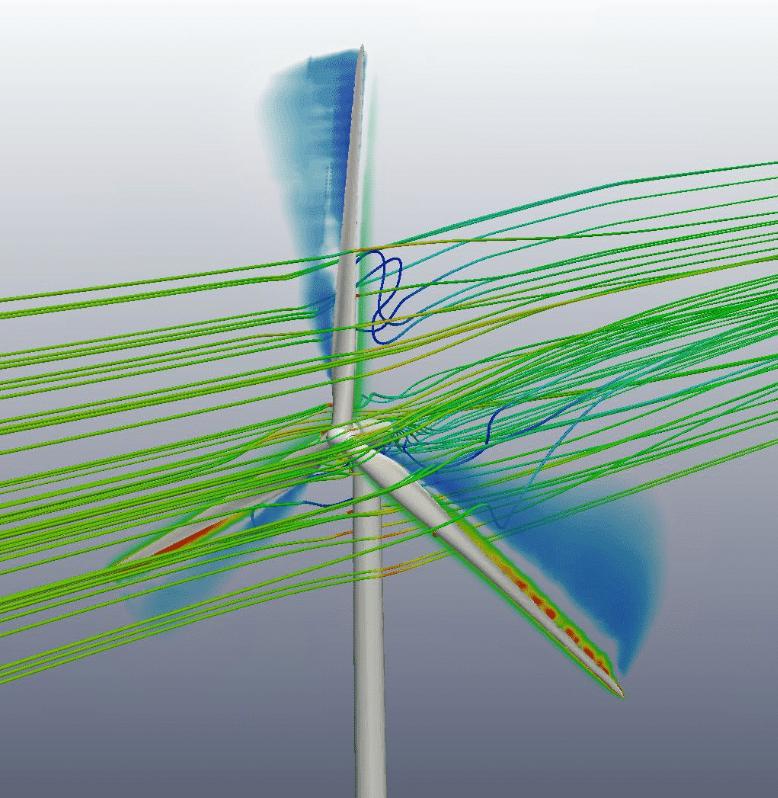
Modern engineering systems are becoming increasingly complex, requiring numerical simulations that accurately capture the interaction between multiple physical phenomena. In applications ranging from aerospace and automotive engineering to energy systems and industrial machinery, the behavior of a component is rarely governed by a single physical field. Structural deformation, fluid flow, acoustic wave propagation, and mechanical vibrations are often strongly interconnected, making their combined analysis essential for reliable performance predictions and efficient product development.
At the same time, industrial simulation workflows increasingly rely on highly specialized computational tools, each developed and optimized for a particular physical problem. Computational Fluid Dynamics (CFD), Computational Structural Mechanics (CSM), and Computational Acoustics (CA) employ different mathematical formulations, numerical discretizations, and solution algorithms. While these specialized tools provide advanced capabilities within their respective disciplines, integrating them into a unified multiphysics simulation environment remains a significant challenge. Developing a single numerical framework capable of addressing all relevant physical phenomena is often impractical, particularly when established industrial workflows depend on validated software solutions developed over many years.
Modularity therefore represents a fundamental requirement for modern industrial simulation environments. Rather than replacing existing numerical tools, an attractive alternative is to establish flexible computational strategies that enable independently developed solvers to communicate and interact. This concept forms the foundation of co-simulation, where different physical subsystems are solved using dedicated numerical tools while exchanging information through well-defined coupling interfaces.
Within this context, partitioned solution strategies offer a particularly promising approach to multiphysics simulations. Unlike monolithic formulations, in which the governing equations of all interacting physical fields are assembled into a single coupled system, partitioned approaches preserve the independence of the participating solvers. This enables the reuse of established numerical methods, allows each physical field to employ an appropriate discretization and solution strategy, and facilitates the integration of heterogeneous simulation technologies within a common computational workflow.
However, the flexibility offered by partitioned approaches introduces additional numerical challenges. Since the participating solvers are developed independently, their spatial discretizations, temporal integration schemes, and mathematical representations may differ considerably. Consequently, the coupling process must ensure that physical quantities such as displacements, velocities, forces, and pressures are transferred accurately and consistently between the interacting domains. In particular, the treatment of non-matching coupling interfaces, the conservation of exchanged quantities, and the numerical stability and convergence of the coupled solution are critical aspects that can directly influence the reliability and computational efficiency of the overall simulation.
These challenges become especially relevant when combining conventional discretization techniques, such as the Finite Element Method (FEM) and Finite Volume Method (FVM), with more advanced numerical formulations. Among these, Isogeometric Analysis (IGA) provides an attractive connection between Computer-Aided Design (CAD) and numerical simulation by employing spline-based representations for both geometry and solution fields. Its ability to preserve geometric accuracy and provide higher-order continuity offers important advantages for structural mechanics and coupled multiphysics applications. Building upon this concept, Isogeometric B-Rep Analysis (IBRA) extends the isogeometric paradigm to complex CAD boundary representations, enabling the direct analysis of trimmed and multipatch spline geometries without requiring conventional geometry simplification and remeshing procedures. However, integrating IGA and IBRA models into partitioned multiphysics environments introduces additional challenges, particularly when coupling spline-based structural representations with conventional discretizations. These differences require suitable interface mapping strategies capable of ensuring accurate and consistent information transfer between independently discretized computational domains.
The central motivation of this research is to contribute to the development of accurate, robust, and modular computational strategies for partitioned multiphysics simulations within the context of Isogeometric B-Rep Analysis (IBRA). Particular attention is devoted to the coupling of heterogeneous numerical formulations, the consistent transfer of information across non-matching interfaces, and the integration of isogeometric structural models into established simulation workflows. By addressing these challenges, the research aims to facilitate the application of advanced numerical methods within flexible co-simulation environments while preserving the independence and specialization of the participating solvers.
To pursue these objectives, three complementary research directions are explored in the following sections. The first focuses on interface mapping strategies for topologically conforming discretizations, addressing the transfer of physical quantities between independently discretized curves and surfaces, with particular emphasis on isogeometric representations. The second investigates consistent coupling operators for geometrically nonlinear isogeometric beams, enabling the reconstruction of their physical surfaces and the transfer of kinematic and dynamic quantities between reduced-dimensional structural models and surrounding computational domains. Finally, the third explores partitioned vibroacoustic coupling involving isogeometric structural and acoustic models, illustrating how independently formulated structural and acoustic solvers can be integrated within a modular computational framework.
Interface Mapping Strategies for Non-conforming Conforming Discretizations
One of the fundamental challenges in partitioned multiphysics simulations is the exchange of information between independently discretized computational domains, as showed in Figure 1. Although the participating solvers may share the same physical coupling interface, their numerical representations often differ in terms of mesh resolution, element topology, and approximation spaces. Such non-conforming interface discretizations require dedicated mapping strategies to ensure the accurate and consistent transfer of physical quantities, including displacements, velocities, and forces.
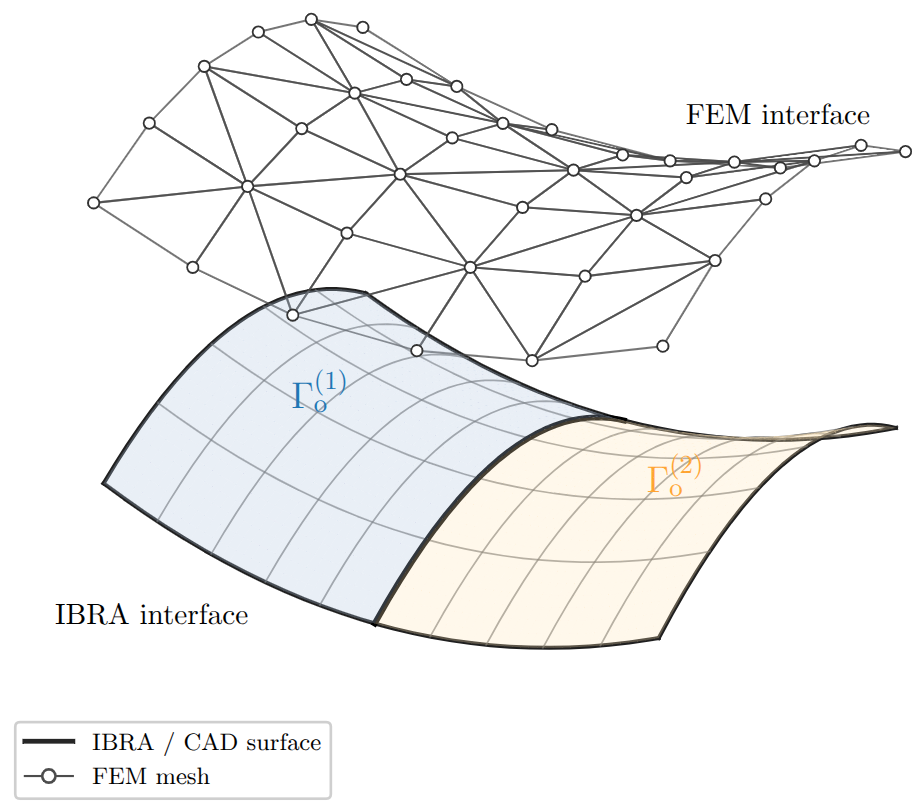
The coupling of conventional numerical methods with Isogeometric Analysis (IGA) and Isogeometric B-Rep Analysis (IBRA) introduces additional challenges due to differences in their approximation spaces and geometric representations. These challenges become particularly relevant when considering trimmed geometries and multipatch CAD representations, where the coupling interface may consist of several spline patches with complex boundaries.
Several families of interface mapping operators can be employed to address these challenges. These include nearest-neighbor (NN) and nearest-element (NE) mapping, which rely on geometric proximity and element-based interpolation, respectively; radial basis function (RBF) interpolation, which constructs continuous approximations from spatially distributed interface data; and mortar-based mapping, which employs variational projection techniques to transfer quantities between non-matching discretizations.
An important distinction lies in how these operators establish the transfer of information. In the considered interpolation-based approaches, mapping is typically performed between FEM interface nodes and Gauss points located on the physical IBRA interface. In contrast, mortar-based approaches establish a variational coupling between FEM nodal degrees of freedom and IBRA control-point degrees of freedom, accounting for their respective approximation spaces.
The present research investigates these mapping strategies for non-conforming curve-to-curve and surface-to-surface interfaces, explicitly considering trimming operations and multipatch representations. Their suitability is assessed in terms of mapping accuracy, consistency, conservation properties, and computational efficiency, aiming to support the reliable integration of CAD-based isogeometric models into modular multiphysics simulation environments.
Further methodological details and numerical investigations will be presented following the submission of the corresponding research manuscript for journal publication.
Consistent Beam-to-Surface Mapping for Geometrically Nonlinear Isogeometric Beams
In many engineering applications, slender structural components, such as aircraft wings, rotor blades, and flexible mechanical structures, can be efficiently represented using reduced-dimensional beam models. Within Isogeometric Analysis (IGA), spline-based beam formulations offer smooth geometric descriptions and higher-order continuity while substantially reducing the number of structural degrees of freedom compared with three-dimensional models. However, their integration into partitioned Fluid–Structure Interaction (FSI) simulations introduces an additional challenge: while the structural response is described along a one-dimensional beam centerline, the surrounding fluid interacts with the physical surface of the structure.
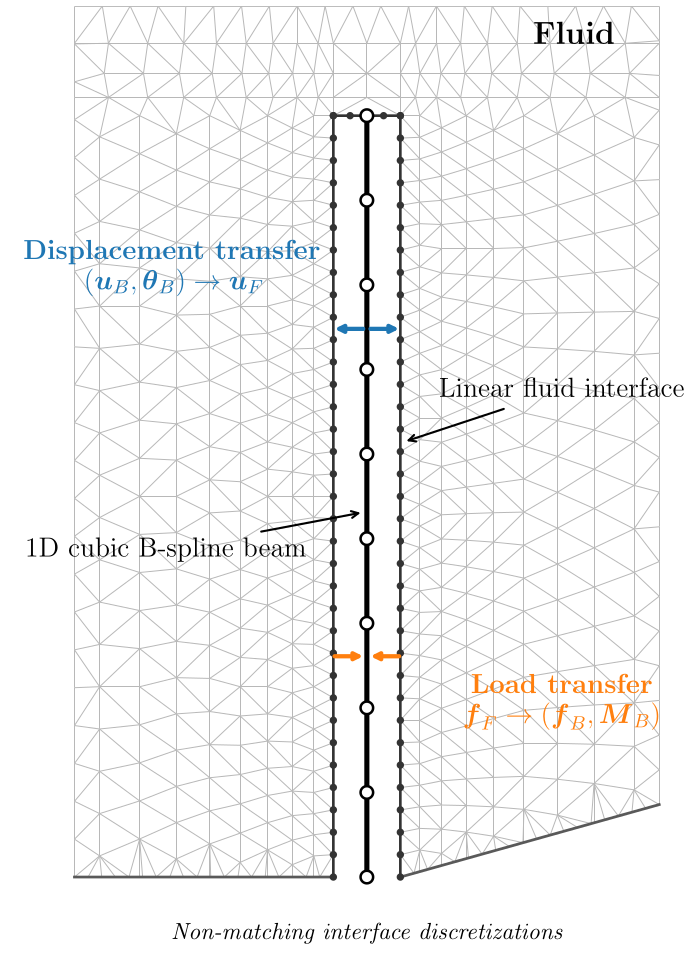
To overcome this dimensional mismatch, specialized beam-to-surface mapping operators are required to reconstruct the motion of the fluid–structure interface from the beam’s translational and rotational kinematics. This becomes particularly challenging under geometrically nonlinear deformations, where large displacements and rotations must be consistently accounted for. Moreover, the mapping must accommodate the different kinematic assumptions of Bernoulli and Timoshenko beam formulations, particularly regarding the description of cross-sectional rotations.
The present research investigates consistent beam-to-surface mapping strategies for geometrically nonlinear isogeometric Bernoulli and Timoshenko beams. Surface points are associated with the beam in the reference configuration, and their positions are subsequently reconstructed according to the nonlinear kinematics of the corresponding beam formulation. Particular attention is devoted to ensuring a work-conjugate transfer of interface quantities, such that the reconstructed surface motion and the corresponding transfer of fluid forces and moments remain mechanically consistent.
These developments aim to facilitate the integration of computationally efficient isogeometric beam models into partitioned FSI simulations, enabling reduced-dimensional structural representations to interact with independently discretized fluid domains.
Further methodological details and numerical investigations will be presented following the submission of the corresponding research manuscript for journal publication.
Partitioned Co-Simulation for CAD-Integrated Vibroacoustic Problems in Unbounded Domains
The prediction and control of structural vibrations and noise radiation are essential aspects of modern engineering design, particularly in industries such as automotive, aerospace, transportation, and renewable energy. The increasing use of lightweight and flexible structures further emphasizes the importance of accurately predicting vibroacoustic interactions, where structural vibrations generate acoustic pressure waves in the surrounding medium, while the resulting acoustic pressures may influence the structural response. Reliable numerical simulations of these phenomena are therefore crucial for evaluating noise, vibration, and harshness (NVH) characteristics and improving the acoustic performance of engineering components.
From a computational perspective, vibroacoustic simulations often require the combination of specialized numerical formulations. While the Finite Element Method (FEM) and its isogeometric extensions are well suited for structural dynamics, the Boundary Element Method (BEM) offers particular advantages for exterior acoustics, as it naturally accounts for sound radiation into unbounded domains without requiring a volumetric discretization of the surrounding medium. However, conventional monolithic coupling approaches generally require the structural and acoustic formulations to be integrated into a single numerical system, limiting software modularity and the independent development of specialized solvers.
To overcome these limitations, this research introduces a partitioned co-simulation framework for CAD-integrated vibroacoustic analysis, coupling an Isogeometric B-Rep Analysis (IBRA) structural solver with an Isogeometric Boundary Element Method (IGA-BEM) acoustic solver. Both formulations operate directly on CAD-based spline representations while retaining independent discretizations and solution procedures. The framework supports both one-way and two-way coupling, enabling the exchange of structural displacements and acoustic pressures across non-matching interfaces.
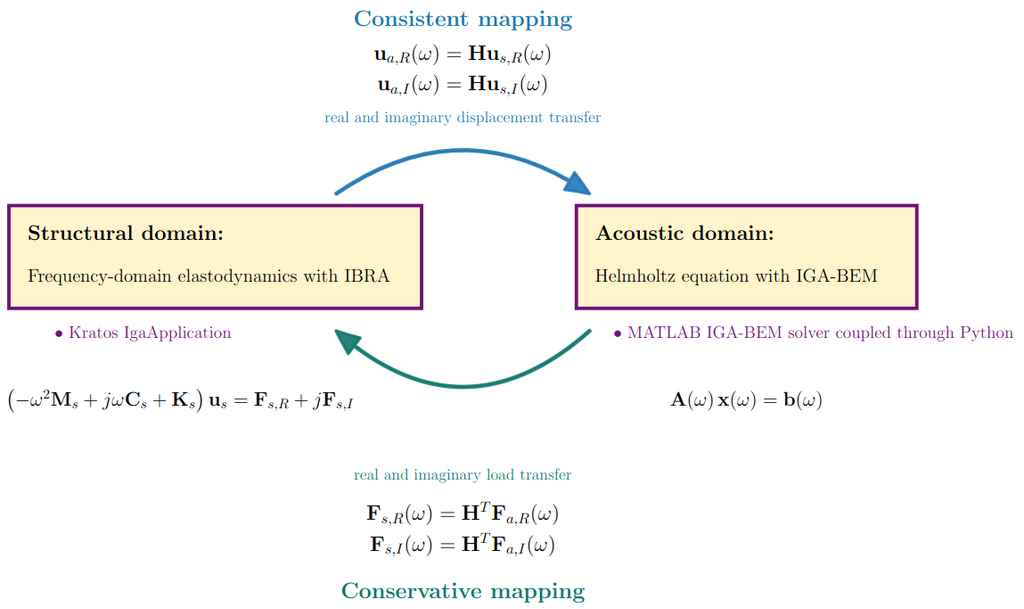
A particular challenge arises from the frequency-domain formulation, where the exchanged interface quantities are complex-valued and contain both amplitude and phase information. To address this, established convergence acceleration techniques, including Aitken dynamic relaxation and Interface Quasi-Newton with Inverse Least-Squares (IQN-ILS), are extended to operate directly on complex-valued interface quantities. This allows the iterative coupling procedure to account for the phase relationships between the structural and acoustic fields, improving the robustness and convergence behavior of strongly coupled simulations.
The proposed methodology is assessed through numerical benchmark problems involving thin-shell structures and exterior acoustic domains. Both one-way and fully bidirectional vibroacoustic interactions are considered, with the partitioned solutions compared against monolithic reference formulations. The numerical investigations demonstrate excellent agreement between the approaches, while the complex-valued convergence accelerators improve the efficiency and robustness of the iterative coupling procedure without compromising solution accuracy.
The corresponding manuscript, “Partitioned Co-Simulation for CAD-Integrated Vibroacoustic Problems in Unbounded Domains” has been submitted to Engineering with Computers and is currently under review. A preprint is publicly available on arXiv, providing further details on the numerical formulation, coupling algorithms, and numerical results.
Conclusions and Outlook
The research presented here contributes to the development of accurate, robust, and modular computational strategies for partitioned multiphysics simulations within the context of Isogeometric Analysis (IGA) and Isogeometric B-Rep Analysis (IBRA). By addressing different challenges associated with the coupling of heterogeneous numerical formulations, these investigations aim to facilitate the integration of advanced CAD-based analysis techniques into existing co-simulation environments.
The three research directions highlight complementary aspects of this objective: the consistent transfer of information across non-conforming interfaces, the coupling of geometrically nonlinear isogeometric beam models with surface-based discretizations, and the development of partitioned strategies for vibroacoustic simulations in unbounded domains. Together, they illustrate the potential of partitioned approaches to combine specialized numerical formulations while preserving solver independence and computational flexibility.
Looking ahead, ongoing research focuses on extending partitioned co-simulation strategies to embedded numerical methods for Fluid–Structure Interaction (FSI). Particular interest is devoted to the Generalized Shifted Boundary Method (GSBM) for both fluid and structural domains, with the aim of enabling coupled simulations on non-body-fitted discretizations. By reducing the dependence on boundary-conforming meshes, these approaches offer promising opportunities for simplifying geometric preprocessing and accommodating complex geometries within modular multiphysics workflows. The investigation of suitable coupling strategies and interface transfer operators for such embedded formulations represents a natural continuation of the research presented here.
Leave a Reply
Want to join the discussion?Feel free to contribute!